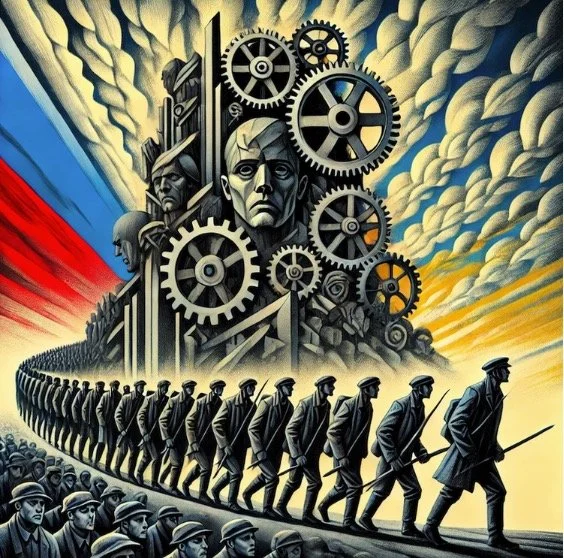
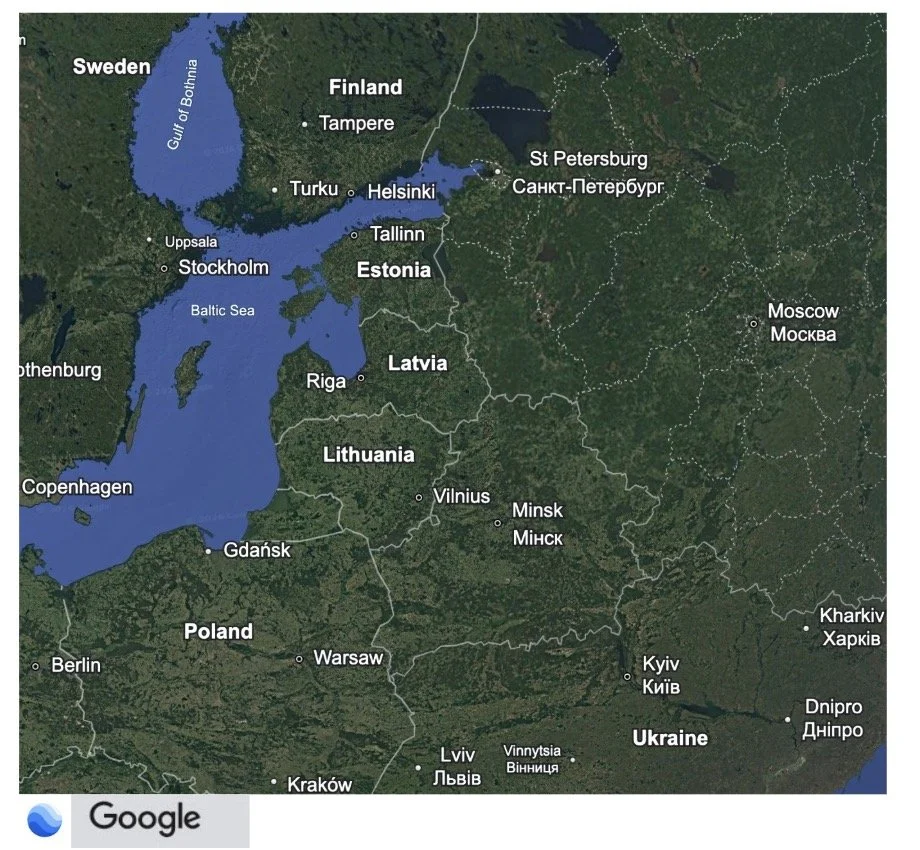
A fleet of drones sweeps over the waters of the Gulf of Finland to attack St Petersburg on 3 June, the very day ‘Russia’s Davos’, its annual economic forum, was getting underway. This attack on President Putin’s hometown prompted British commentator Andrew Marr to celebrate that “Putin’s war certainly wasn’t going well.” The Economist's Russia editor, Arkady Ostrovsky, gloated over the attack on “the shopping window of Putinism”. But is this really a cause for celebration?
In recent weeks swarms of Ukrainian drones have traversed the Baltic states on missions to take the war to Russian cities like St Petersburg. The Baltic governments and NATO have claimed that these drones were redirected by Russian electronic jamming; but the advantage for the Ukrainians of flying over NATO territory is clear:the ability to avoid interception, possibly even detection, by Russian defence systems – as much of the journey is within NATO territory. Who gave the green light for this? If this was indeed a deliberate Ukrainian strategy, were, for example, political leaders of Finland, Latvia, Lithuania or Estonia secretly consulted? Were NATO military commanders in the loop? Narratives and counter-narratives swirl around this use of NATO territory to attack the Russian Federation. It is the latest in a string of “incremental escalations” that military and geopolitical analysts I follow fear may be some of the opening shots in transitioning the “Russo-Ukrainian War” (with massive Western backing) into an open “Russo-European War”. God help us all.
I spoke with Anatol Lieven, director of the Eurasia Program at the Quincy Institute for Responsible Statecraft in Washington this week about the drone attacks and the lack of diplomacy that could avert a wider war.
“The Russians have now threatened very harshly that this must stop,” Lieven says. “They claim that the Ukrainians are already establishing launch sites in Latvia.”
NATO and the Baltic states appear to have taken this threat seriously. The Latvian prime minister and defence minister have been forced to resign, and NATO has begun – belatedly – to shoot down Ukrainian drones flying over the Baltic states.
Powerful voices in elite Russian policy circles are critical of the country’s current limited response to the increase in attacks inside Russia and the involvement of the CIA and NATO, reported in the New York Times, in coordinating many of these. Sergei Karaganov, an influential former Kremlin advisor, has said repeatedly that the West is complacent about the dangers of ignoring Russia’s “red lines”. It is time for Russia to restore deterrence, he says, through powerful strikes into the West. Again, God help us all.
The use of massively powerful nuclear-capable Oreshnik hypersonic missiles by Russia on the Ukrainian capital last week – only the third time they have been fired in war may have been as polite a warning as the Russians give. It was followed by other increasingly large drone and missile strikes in the days that followed, partly signalling that Russia’s military-industrial sector is now approaching peak production. Both sides are working their way up the escalation ladder.
The danger analysts recognize is that Ukraine, desperate for additional support, is resorting to measures – launching attacks via NATO territory, for example – designed to draw the Europeans and thereby, they hope, the Americans, into an expanded war.
The Quincy Institute’s Anatol Lieven is by descent a scion of a Baltic German family which served successively the Teutonic Knights, the Kings of Sweden and the Tsars for 700 years. He says that despite recent Ukrainian successes and growing Russian war-weariness, the courage and determination of the Ukrainians also has its limits. Europeans must rediscover the lost art of diplomacy, not least to save Ukraine.
“The reality on the ground is that the Ukrainians have fought the Russians to a standstill,” Lieven says. “For two years now, people have been saying the Russians will soon conquer the whole of the Donbas but progress has been glacial. However, I find all this language now in Europe – and sometimes in America – that this means somehow that Ukrainians can win, can drive the Russians back, seems to be absolutely crazy. Exactly the same military factors, above all, drones, of course, satellite intelligence, and mines, that have frustrated the Russian advance will frustrate a major Ukrainian advance.
“If you want a recipe for Ukrainian defeat, it's that the Ukrainians should repeat what they tried to do in 2023 – launch a major offensive against Russia. The Ukrainians don't have the men to lose, so this is grossly stupid and irresponsible stuff brought about above all because the Europeans have through some mixture of paranoia, hatred and moral cowardice dug themselves into a position where they cannot bring themselves to swallow the propaganda they've been putting out over the past three years. We've got to offer the Russians something. If you want to be at the negotiating table: What are you proposing? What is your peace plan? What are you prepared to offer?”
Key issues that the Russians have called for are Ukrainian neutrality (no NATO membership) and an acceptance that Russia holds on to the ethnic Russian east it seized after the civil war of 2014-2022 transitioned into a Russo-Ukrainian war.
Most Ukrainians seem to have reconciled themselves to the de facto loss of the territories occupied by Russia, but the government and apparently a majority of citizens remain opposed to giving in to the Russian demand to surrender the last portion of the Donbas held by Ukraine.
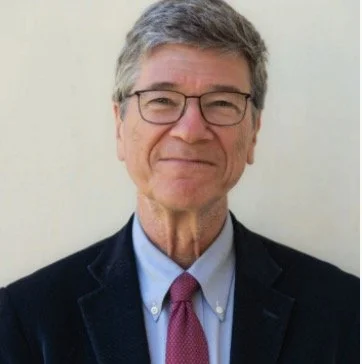
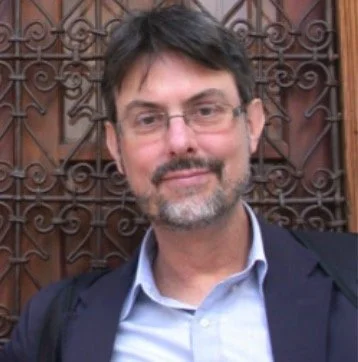
Central to this discussion and crucial to seeing an end to the immensely damaging war is that long-forgotten word: diplomacy. Important analysts like Anatol Lieven, Norway’s Professor Glenn Diesen, and US economist Professor Jeffrey Sachs decry the absence of serious diplomacy to bring the war to an end. It was Sachs who described the Baltics recently as the most dangerous place on earth today.
Safely removed from the violent realities on the ground, European heads of state and foreign ministers wear it as a badge of honour that they refuse to have any dialogue with their Russian counterparts. I find this a bit rich coming from an alliance of nations that are up to their eyeballs in genocide and various wars of aggression at the moment.
“Well, that's it,” Anatol says. “Russophobia is paraded around, including by some academics, as if it was something like the German resistance to the Nazis, all covered with this ludicrous glow of not just morality, but also civil courage. It's actually deeply conformist and good for their careers. Courage? When it comes to taking stances that would actually make them unpopular – let alone risk their jobs – on Israel, for example, or on the Iran war – there is silence.”
European governments are now beginning to talk of appointing a representative to negotiate with Moscow, but the talk is all of "confronting" Putin, not making offers that could bring about a settlement to end the war.
I’ll give the last word to Professor Diesen, author of The Ukraine War & the Eurasian World Order, who wrote to his followers this week about the Western obsession with shutting down discussion:
“There is a strange development in which academics of international politics are expected to publicly condemn adversarial countries before they are allowed to participate in public discourse. The complexity of international politics is reduced to a moral question of good versus evil, and academics must make moral declarations before even discussing facts, history, strategy, and interpretations. Academics should explain why states behave as they do; they are not moral validators.
“When the conclusion is always that the good guys are confronting the bad guys, then the solution is always "peace through strength", "weapons are the path to peace", and defeating the latest reincarnation of Hitler. If you want war, condemn the other side as pure evil. If you want peace, the first step is to understand the other side.”
Eugene Doyle
Eugene Doyle is a writer based in Wellington, New Zealand. He has written extensively on the Middle East, as well as peace and security issues in the Asia Pacific region. He hosts solidarity.co.nz.
This article may be reproduced without permission but with suitable attribution.