Cuban Ambassador denounces US aggression and violations of international law.
This is a moment of great peril for the small Caribbean nation of Cuba. Nothing less than its sovereignty is on the line as the US drives its knee into the neck of 10 million Cubans by means of a crushing air and sea blockade and a set of secondary sanctions designed to muscle the nations of the world into compliance to the hegemon. The issues are not particular to Cuba; we are in the midst of a militant US that is determined to assert domination through force. It was therefore a pleasure to spend time this week with Luis Ernesto Morejón Rodríguez, Cuba’s ambassador to Wellington, New Zealand.
Standing with Cuba
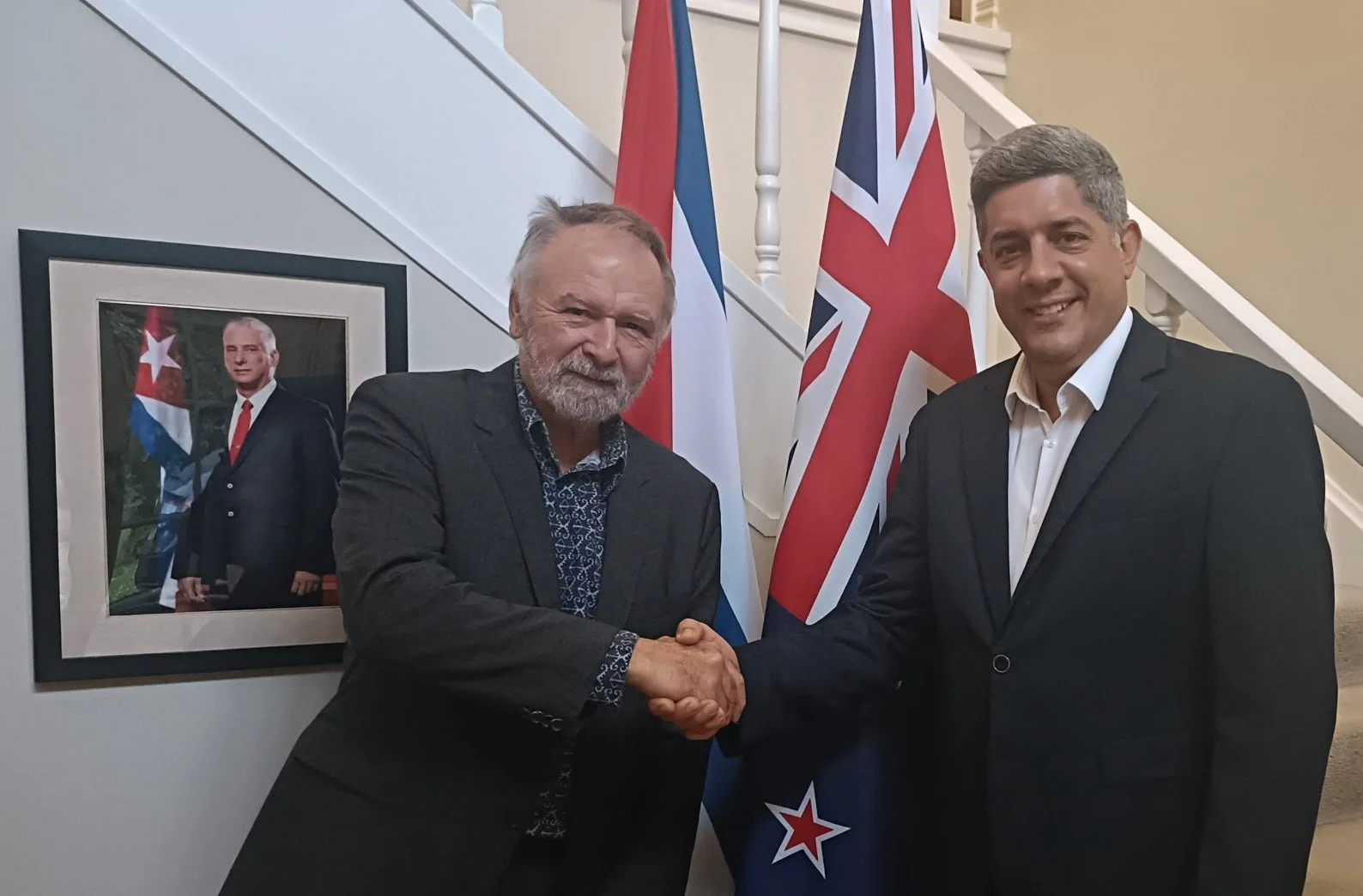
Eugene Doyle (left) with Ambassador Luis Ernesto Morejón Rodríguez.
Eugene Doyle: Canadian Prime Minister Mark Carney’s speech in Davos received considerable attention. He said: “Middle powers must act together because if we are not at the table, we are on the menu.” Cuba has been on the U.S. menu for decades. What would be your message to those who support Carney’s call to “come together to create a third way with impact”?
Ambassador Rodriguez: Cuba believes a genuine “third way” can only exist if it defends the economic sovereignty of states against coercion. For more than sixty years, our country has been subjected to a policy explicitly designed to generate material hardship in order to force political change. The issue therefore is not ideological but systemic: no nation can claim strategic autonomy while tolerating that another punishes third countries for lawful trade. True multilateralism begins when middle-sized nations act collectively to prevent the global economy from becoming an instrument of political pressure.
How does Cuba intend to use the United Nations General Assembly – where it enjoys near-unanimous support – to challenge the legality of “secondary sanctions” that weaponise the global financial system against trade with third parties?
Cuba will continue using the General Assembly to document and expose the extraterritorial nature of these measures. Each year the discussion goes beyond a vote: evidence is presented of banks cancelling humanitarian transfers, shipping companies refusing to transport fuel, and medical suppliers withdrawing contracts due to fear of penalties. The objective is to consolidate an international legal and political consensus that no domestic legislation should be globally imposed or obstruct legitimate trade among sovereign states. The process is cumulative – it builds legitimacy and normative pressure over time.
In what other ways will Cuba navigate this latest campaign of maximum pressure by the United States? What support will it seek?
Historically Cuba responds through a combination of internal resilience and external cooperation: diversifying energy and trade partners, strengthening South-South relations, and promoting alternative financial arrangements. At the same time, priority is given to protecting essential social sectors. Cuba does not seek geopolitical confrontation but economic normality – the ability to purchase food, fuel, spare parts or medicines without third parties being penalized. The support we request is straightforward: respect for our right to trade.
Many people do not follow international news closely. Could you describe life in Cuba today and how the population and government are responding to what must be a severe economic crisis and the threat of U.S. pressure?
Daily life is marked by material scarcity linked to severe financial and energy restrictions. Limited access to fuel can lead to extended power outages; families organize cooking around electricity availability and neighbours share refrigeration space to prevent food spoilage. Hospitals maintain essential services using constrained backup power systems. Despite this, the state preserves universal health and education, and communities rely heavily on solidarity networks. It is less a conventional economic cycle than a society operating under continuous external pressure.
For an audience in Wellington that might interpret this as a “political dispute”, what does “maximum pressure” mean for a Cuban mother trying to feed her children, or for a doctor performing surgery during a 20-hour blackout?
Maximum pressure is experienced through ordinary situations: planning daily meals around electricity schedules, transporting patients when fuel for ambulances is scarce, or sterilizing medical instruments under limited power conditions. These are not political slogans but cumulative consequences of restrictions that prevent the country from freely purchasing fuel, spare parts or financing. Administrative decisions taken abroad translate into domestic difficulties at home.
In the West we often speak about international law but do not always apply it to ourselves. What is your message to those who want to live in a world governed by law rather than force?
Cuba asks for legal consistency: if international trade is rule-based, no country should be penalized for lawful commerce. We also recognize and appreciate New Zealand’s consistent favorable vote in the United Nations General Assembly in support of the resolution entitled “Necessity of ending the economic, commercial and financial embargo imposed by the United States of America against Cuba.” That position reflects a principled commitment to multilateralism. In this context, we have encouraged New Zealand to continue upholding its traditional opposition to unilateral coercive measures and to the extraterritorial application of national laws. Silence regarding such sanctions weakens the very legal principles that protect all small states alike. The issue extends beyond bilateral relations — it concerns the integrity of international law itself.
What is your life like as a diplomat in New Zealand? How is your contact with government officials and the diplomatic community?
Diplomatic work in New Zealand takes place in a serious institutional environment where dialogue exists even amid disagreement. Our exchanges with officials are respectful and professional; positions may differ, but there is willingness to listen and understand context. Much of our work here is explanatory rather than confrontational: clarifying that the Cuban situation is not merely a bilateral dispute but part of a broader debate about how the international order functions. The diplomatic community in Wellington is active and collegial, allowing frank discussions on global issues such as climate change, development and multilateralism.
The U.S. objective is explicitly described as regime change through economic collapse. If Cuba yielded to these demands, what would the Global South lose?
A crucial precedent would be lost: that a nation can choose its political system without external tutelage. If prolonged economic strangulation succeeded in imposing internal change, it would legitimize a model of intervention applicable to any developing country. It would no longer be necessary to negotiate with societies – sustained financial pressure would suffice. The Global South would see its effective autonomy reduced.
What is your vision for Cuba? Where would you like it to be in 10 or 20 years?
The aspiration is a fully normalized Cuba within the global economy – able to access financing, trade, and technology without restrictions – while preserving universal social policies in health, education, and equity. Change will continue, but it should occur by national decision, not external pressure. In twenty years we hope Cuba will be known less for conflict with a major power and more for contributions in medical cooperation, biotechnology innovation, cultural exchange, and regional development. The ultimate goal is not perpetual resistance, but the freedom to choose its own path.
Eugene Doyle