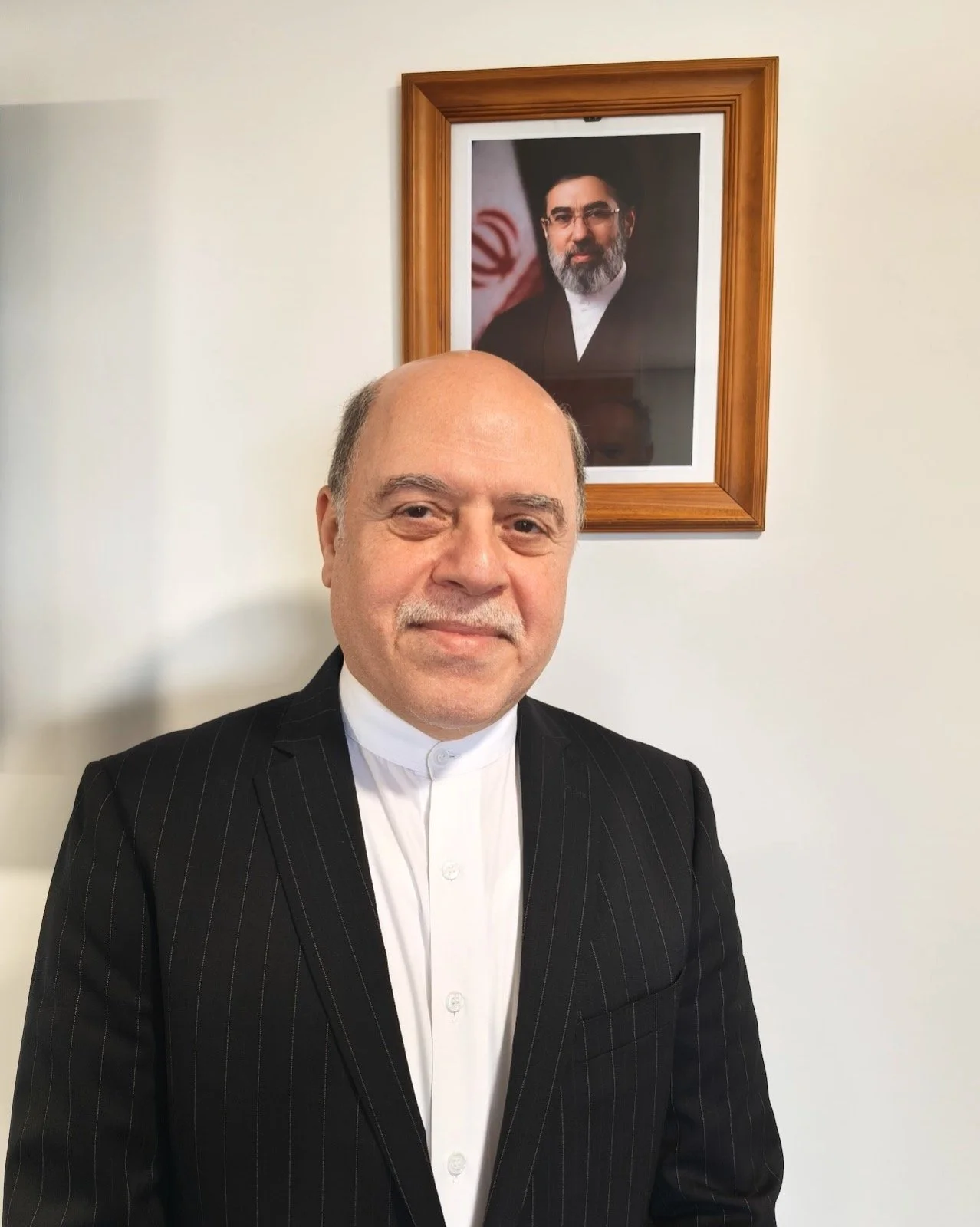
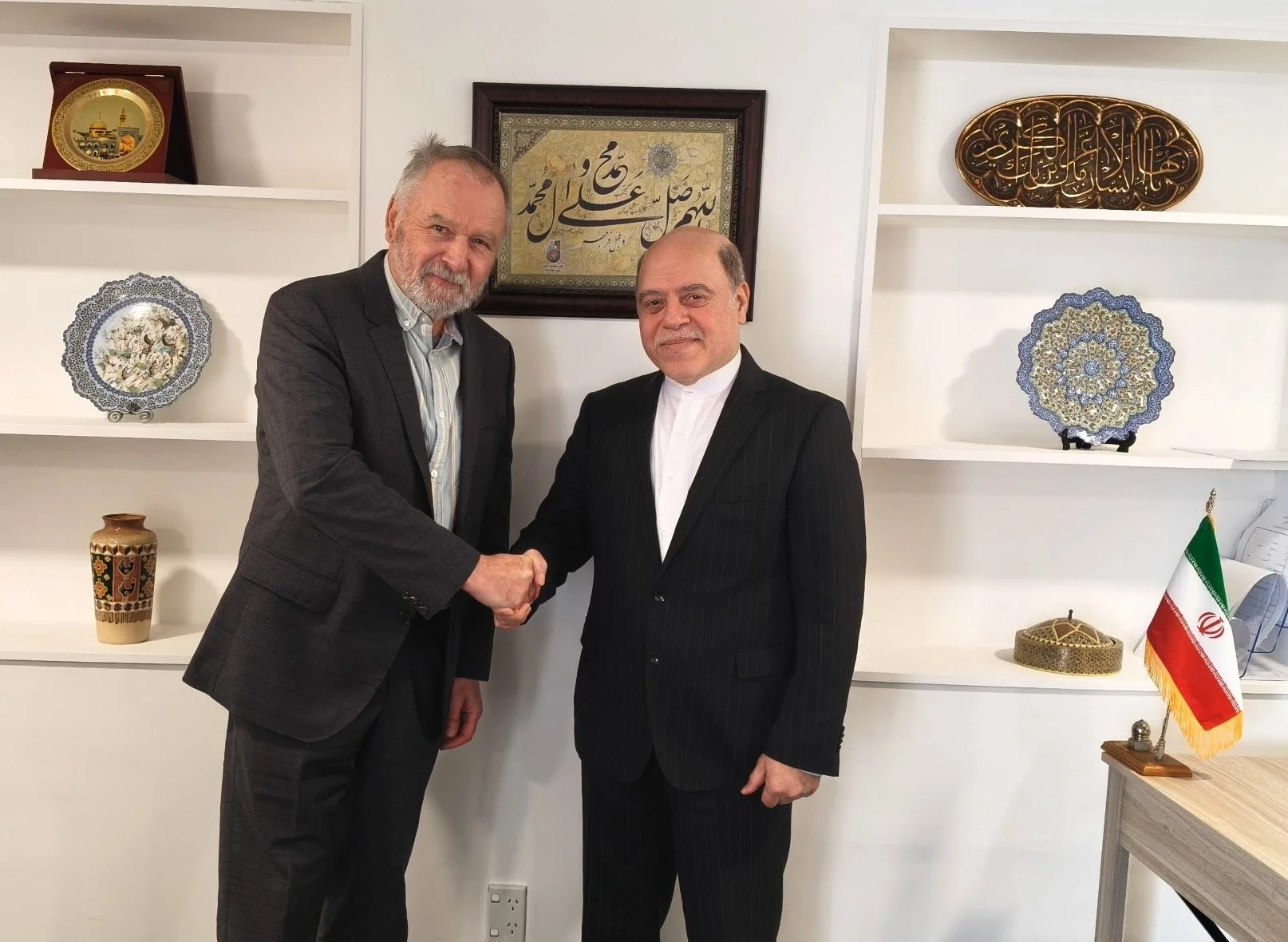
In this interview with His Excellency Reza Nazar Ahari, the Iranian Ambassador to Wellington, we discussed the war, the state of diplomacy with the West, issues of sovereignty, defence and the internal politics of Iran. He provided some fascinating analysis into why the Western strategy on Iran has been so disastrously flawed.
The US has stated many objectives, many reasons for launching the war. For Iran, what is at stake?
The Americans have come to take control of all things in Iran – not just the oil of Iran and the land of Iran, but to take control of Iranians’ own identity, our independence and our way of life.
President Trump said once during the war, “a whole civilization will die tonight, never to be brought back again”. In spite of having suffered enormous damage and paid a heavy price, Iran has to defend itself because otherwise there will be no Iran.
Especially in the West, the way to eliminate your enemy is not only by hard power, by artillery, by guns. There are many other means: by the media, by demonising, by culturally attacking a country, by imposing sanctions. In the last decades we have been under all of these types of attacks. We are one of the best in the world in knowing how to counter all of these attacks.
What we’re seeing from Iran is you are very powerfully standing up for Iranian sovereignty in the face of an astonishing assault.
National identity is the main asset of any nation and it should be studied first. When President Trump said, “Iran must unconditionally surrender”, it suggests he has not read the history of this nation. Surrender is the worst thing for us. It’s the same with calling for zero enrichment, giving up our missiles and our allies – they don’t understand the identity of the Iranian people. We fought against Saddam Hussein for 8 years to ensure we did not lose a centimetre of our land. When you don’t understand things like that, it can cause many mistakes, as we have seen.
This brings us to the important role that diplomats and analysts should play in helping foreign states understand the unique culture, political dynamics, and so on, of a country.
When you look back a century, when the British Empire wanted to have influence in our region, they sent their scholars, their scientists, their researchers to our countries. They lived with us, and understood the identity of the people. I’m not arguing about bad decisions or good decisions, but the decisions were always made through that very close study. Today “expert” Americans just sit at their desks looking at the internet without knowing what happens in the heart of Iranians, in the mind of Iranians.
What you are suggesting is that an at-distance unfamiliarity with Iranian culture has led to strategic blunders that have hurt not just Iranians but Americans and the West.
Exactly. Americans started their war against Iran on the basis of what they did in Venezuela, and also what they were told by Israelis – “You target this, you kill these people, and all the people will come out to change their government.” It was very simplistic, very superficial, which helps explain why they failed.
Another mistake by Americans is that they think they can solve their problems with guns and missiles. They think that solves all problems, without the need to rethink, to analyse and to take a more profound approach.
How should the war launched by the US and Israel on 28 February be viewed through the lens of the United Nations Charter and its core principles, for example, the prohibition on the use of force and the respect for the territorial integrity of states?
There are obvious positions stated in the Charter of the United Nations that when a country is attacked or invaded by any country, it is the responsibility of other countries to condemn the attack and to help to stop that. New Zealand did so in the Russia–Ukraine case. It immediately condemned Russia and imposed sanctions. However, when it came to Iran, there was no condemnation of the United States or the Israeli regime, nor were any sanctions imposed on them.
In the case of Iran, some countries even expressed positions in support of the aggressor rather than the country that had been attacked.
The West loves to talk about the international rules-based order, but as you said, we seem to be moving to the rule of the gun which is a tragedy for all of us. What would your advice be to medium-sized powers like New Zealand? How should they respond to that situation?
It is strange if a country – any country – makes their policies exactly like a country on the other side of the world just because they are allied nations. I believe each country should live according to their identity, not according to their alliances.
Each country has a unique identity, has unique geography, has unique capabilities, unique history, and according to them they should identify their unique foreign policy.
When we looked back in time at New Zealand, we found a sense of independence, making your own identity. In the past, for example, I think New Zealand very correctly believed that no nuclearisation should happen around its waters from both an environmental and from an international political point of view.
What is your rapport with the Ministry of Foreign Affairs?
Actually, it was strange to me, because after the US broke the ceasefire, the Ministry of Foreign Affairs called me in. When the United States attacked Iran, they didn’t call in the American ambassador; they called me in! But it was an opportunity for me to explain the reason for the recent developments in the Persian Gulf and the Strait of Hormuz.
Your posting here may finish at the end of this year. Any regrets? Any final impressions?
I actually love New Zealand because it gave a very peaceful experience for me and my family. Definitely when I leave New Zealand, I will miss this country and its very good people. I have one regret in regard to my time in New Zealand. I tried but I failed to encourage a think tank in international and political affairs, a space for very serious but informal dialogue with scholars focusing on the Middle East region, diplomats, foreign policy people. This is called Track Two Diplomacy – it is very active in many countries, including Iran. I would encourage something like this in the field of international relations and diplomacy with Iran.
Eugene Doyle
Eugene Doyle is a writer based in Wellington, New Zealand. He has written extensively on the Middle East, as well as peace and security issues in the Asia Pacific region. He hosts solidarity.co.nz.
This article may be reproduced without permission but with suitable attribution.