Sudanese Chargé d’Affaires: Sudan’s war is fuelled by UAE. How to bring peace.
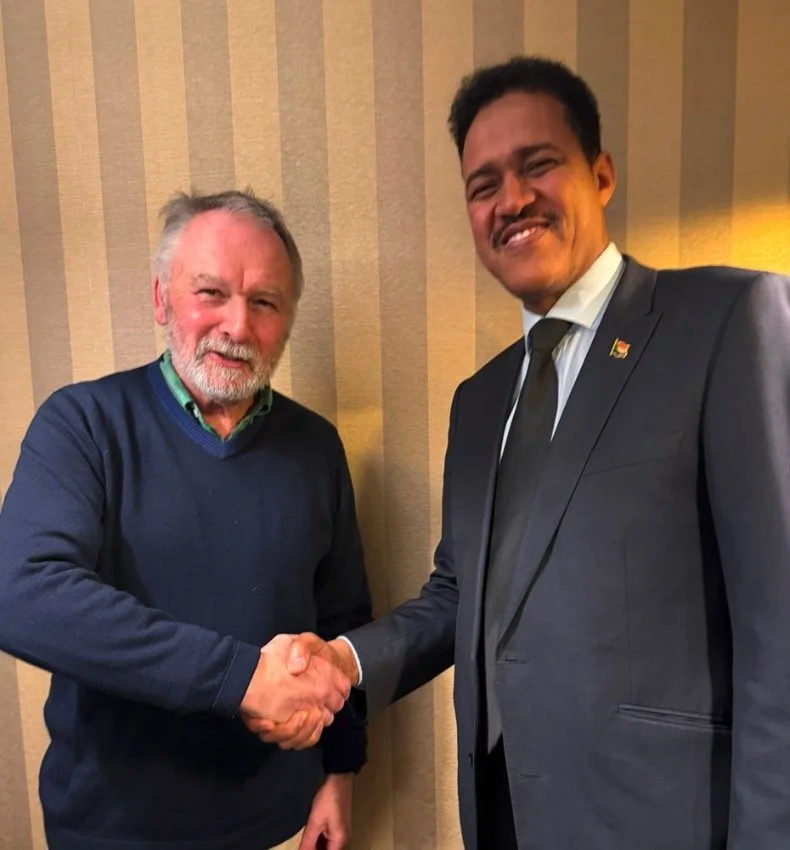
During his recent visit to New Zealand I interviewed His Excellency Ahmed AbdeLatif, Canberra-based Chargé d'Affaires to New Zealand at the Embassy of the Republic of Sudan. We discussed the long-running war, the deep involvement of the United Arab Emirates in fuelling the conflict and the responsibilities of governments, including my own, to take meaningful action to bring the war to a close.
Why should countries like Australia and New Zealand pay attention to Sudan?
Sudan matters because what is happening is not simply a distant humanitarian tragedy. It is a crisis affecting millions of people and raises fundamental questions about sovereignty, international law, the protection of civilians, and the consequences of allowing militia groups to sustain conflict through external support.
Sudan is experiencing one of the world’s largest displacement and humanitarian crises. The conflict began following the failed attempt by the Rapid Support Forces to seize power from the state through armed force. As a result, millions of Sudanese civilians have lost their homes, livelihoods and loved ones, while women and children have been subjected to horrific violence whose consequences have been witnessed and documented by the international organisations and media.
But there is another dimension that deserves greater attention. The conflict has been prolonged by regional political, financial and military interests. External support, including support from the UAE regime to the rebel militia, has played an important role in enabling it to sustain its military campaign. Foreign mercenaries have also been recruited and brought into the conflict.
For Australia and New Zealand, Sudan is therefore also a matter of principle. Australia and New Zealand place considerable importance on international law, multilateralism, national sovereignty and the protection of civilians. These principles should apply to Sudan just as they apply elsewhere.
The media largely describes this as a civil war. How should we understand what is happening?
It is important to be precise in how the conflict in Sudan is characterised. Describing the situation simply as a “civil war” risks obscuring the fundamental circumstances in which the conflict began following the failed attempt by the Rapid Support Forces to seize power from the state through armed force. The Sudanese Armed Forces are the national armed forces of the Republic of the Sudan and constitute the state’s recognised military institution. In responding to the armed rebellion, they have been exercising the state’s responsibility to defend its territory, institutions and civilian population against an armed force seeking to seize political power.
This distinction is important because the rebel militia has received external financing, weapons, logistical support and foreign fighters. The support of the UAE regime has been particularly significant, enabling the militia to sustain the conflict far longer than would otherwise have been possible. The international community must therefore address not only the consequences of the conflict, but also the external support that allows it to continue.
The role of the UAE is enormously damaging. What do people need to understand, and why hasn't the international community protected people in El Fasher and elsewhere in Darfur?
What happened in El Fasher should compel the international community to ask some very difficult questions. The city was under siege for approximately 18 months. The international community knew that civilians were trapped. It knew the history and capabilities of the perpetrators. It knew that certain ethnic communities were at particularly grave risk. The warning signs were clear. This was therefore not fundamentally a failure of information. It was a failure of political will.
The international community cannot credibly claim that it did not know what was happening. International human rights organisations and media reports documented serious abuses by the rebel militia, including ethnic cleansing, mass displacement and sexual violence, including rape, as well as the destruction and uprooting of entire communities.
Civilians cannot be sustainably protected while weapons, financing, logistical support and foreign fighters continue to reach forces responsible for attacking them. Humanitarian assistance is essential, but it cannot substitute for addressing the drivers that sustain the violence.
The military leadership overthrew the civilian government in 2021. How should we view the government today? Are there any angels in this conflict? Are Sudanese people frightened of both sides? Why should we support the Sudanese government? Is this the lesser of two evils?
Sudan’s political transition before the conflict was deeply troubled and complex. Sudanese citizens have legitimate aspirations for a representative, democratic and accountable government. Those aspirations are beyond dispute. But political disagreements do not justify destroying or fragmenting the state through armed force. There are no angels in war, and we should not pretend otherwise.
At the same time, there is a fundamental distinction between a sovereign state defending its territory and institutions, and a rebel militia seeking to seize political power through armed force and establish parallel governing structures.
Supporting the Sudanese state does not give any institution or individual a blank cheque. It means supporting the principle that Sudan’s political future should not be determined by whoever commands the largest militia or receives the greatest amount of external military support. Nor does supporting the state mean rejecting democracy—quite the opposite.
Sudan’s political future must ultimately be decided by its people—but they need a sovereign, united and secure Sudan to make that choice freely.
The human suffering is immense, yet the West appears largely uninterested. Why?
Sudan is too often viewed through the lens of instability, ethnic conflict and humanitarian crisis, as though these were inevitable. They are not.
Sudan does not lack evidence of suffering; what is lacking is a political response commensurate with the scale of the crisis. The lives of Sudanese civilians should not be valued differently because Sudan receives less media attention. The Sudanese people deserve the same solidarity, protection and international attention as victims of any other conflict.
The Government of Sudan is committed to improving its human rights record and ensuring equal protection under the law for all Sudanese citizens. It also recognises that Sudan’s future must ultimately include a civilian democratic transition.
The Government of Sudan, under Prime Minister Professor Kamil Idris, launched the “Government of Hope” initiative for comprehensive peace in December 2025, aimed at creating a path toward a political solution and sustainable peace. Building on this initiative, President Al-Burhan last week called on all Sudanese political parties to begin an inclusive national political dialogue, reaffirming the Government’s commitment to providing the necessary conditions and requirements for reaching a comprehensive political solution. All Sudanese political parties, civil society, professional associations, trade unions, women, youth and other components of society have a legitimate role in shaping Sudan’s future.
At the same time, democracy requires security, stability and effective state authority. Restoring these foundations is not an alternative to democracy, but a necessary condition for it.
What should New Zealand and Australia do? Are they helping or hindering?
We greatly appreciate the humanitarian assistance provided by the Governments of New Zealand and Australia to alleviate the suffering of Sudanese civilians. We believe, however, that both countries can play a greater diplomatic role. With their strong commitment to multilateralism and international law, they can support a genuinely Sudanese-led political process focused on governance, reconstruction and democratic transition.
At the same time, the external support sustaining the rebel militia cannot be ignored. Diplomatic pressure should be directed at those who finance, arm and enable the militia. Without addressing these networks, a lasting ceasefire and meaningful political settlement will be difficult to achieve.
Anything else we need to understand?
Perhaps the most important point is that Sudan’s future must ultimately belong to the Sudanese people. Sudan has the right and responsibility to defend its sovereignty, restore state authority and protect its territorial integrity. But this is not the end of Sudan’s political journey. It must create the conditions for reconstruction, reconciliation, accountability and a credible civilian democratic transition.
Eugene Doyle
Eugene Doyle is a writer based in Wellington, New Zealand. He has written extensively on the Middle East, as well as peace and security issues in the Asia Pacific region. He hosts solidarity.co.nz.
This article may be reproduced without permission but with suitable attribution.