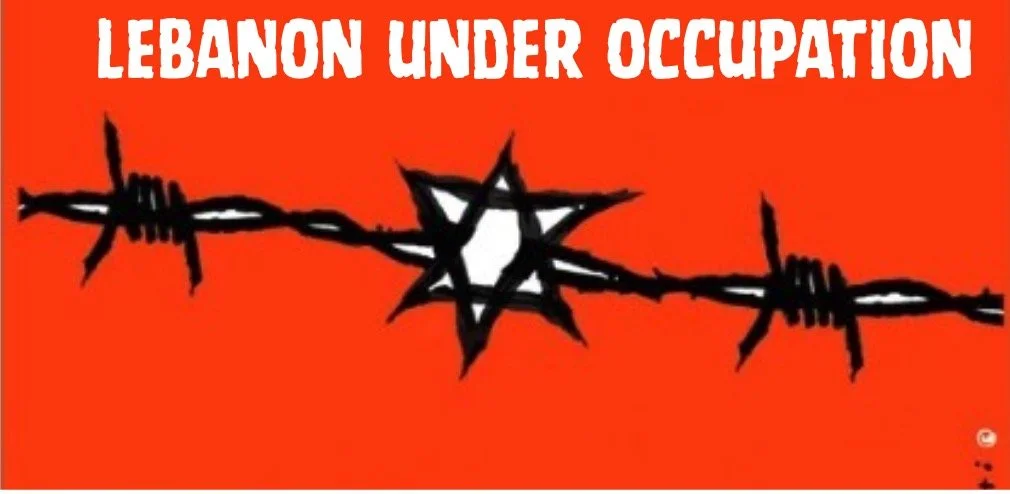
Many people rallying for Gaza are not aware that Lebanon, and the whole region is connected and the south of Lebanon is affected the same way as Gaza by the same enemy soldiers and tanks and F35s, according to Mohamed B (whose identity we are protecting).
Mohamed, from Lebanon, is safe here in Wellington, with his wife and new baby, but his brother in Beirut and his parents in Nabatieh in the south of the country – are living once again on a knife’s edge. They have been displaced from their home for the fourth time due to Israeli bombardment.
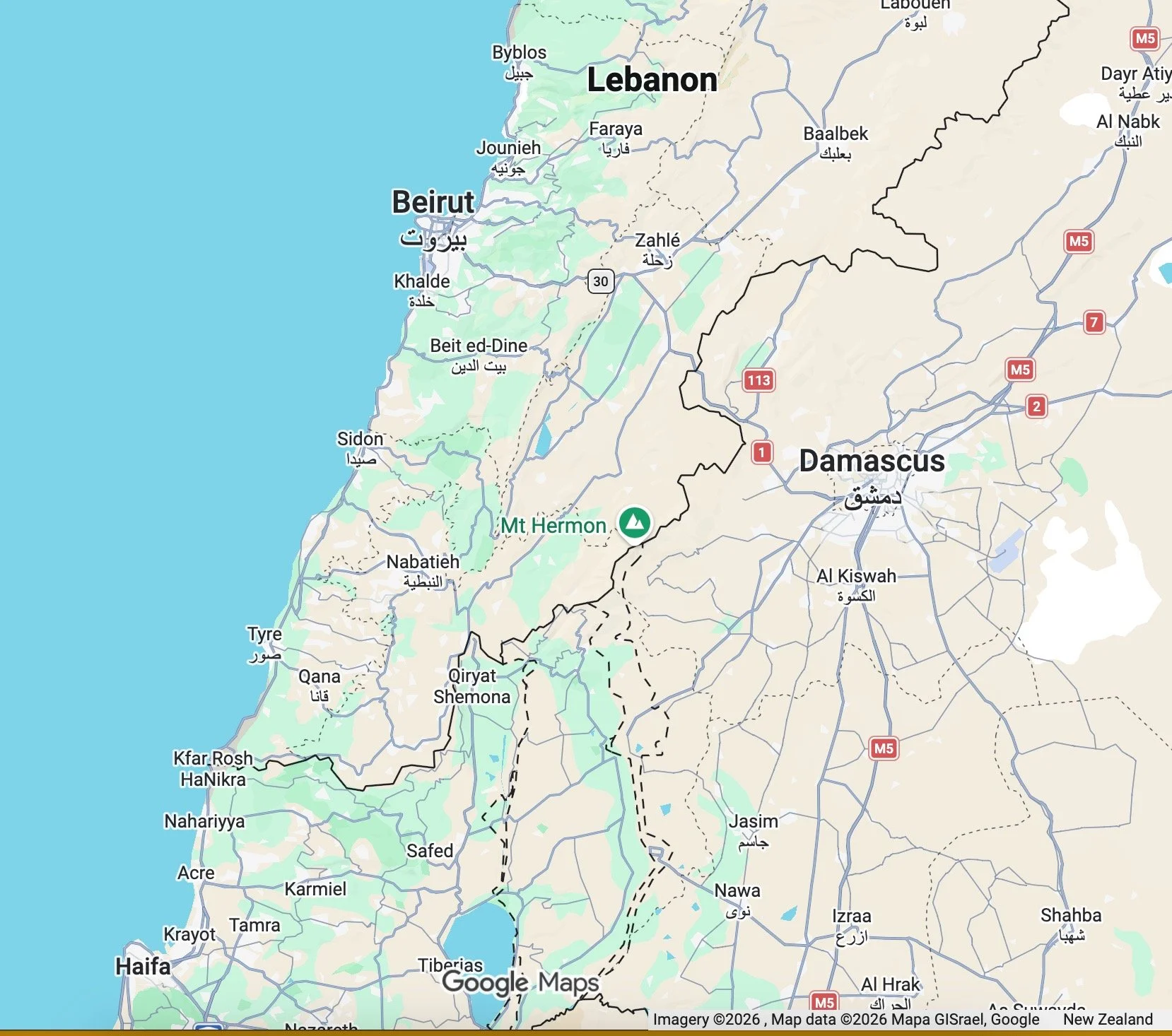
Mohamed, 42, has lived and worked in Wellington for eight years. He met me on the day Israeli forces stormed the UNESCO Heritage site of Beaufort Castle, a 900 year old crusader fortress. I visited Beaufort Castle in 2018 and recall our Lebanese friend pointing out the flag marking the border with Israel in the distance. It looked further than the 7-9 miles Chat GPT tells me it is. But then – borders with Israel tend to be a moving feast. It felt particularly poignant to see the fighting taking place at that ancient site, built to resist attacks by the infidels. Once again religion is the incendiary root of division. Or is it politics? Or an ideology bridging the two? Religion and politics are so enmeshed in the tumultuous history of the Middle East that most simply leave their analysis at ‘it’s complicated.’
The situation in Mohamed’s homeland has deteriorated since March this year after the US-Israeli attack on Iran on February 28. For the beleaguered citizens of south Lebanon, bombardment and displacement is sadly nothing new.
“Even though the focus, rightly so, has been on Gaza and Palestine in general, Lebanon – specifically the south, does not get much attention. The south of Lebanon has been in a state of war since October 8, 2023 – even during the 15 months after the agreed ceasefire in November 2024.
“The people of South Lebanon have been living under continuous bombardment and killing, under the excuse that the IDF is targeting Hezbollah targets. We know in many cases this was not true and the only purpose is to terrorize, dominate and maintain the status quo with complicity of the Lebanese government.”
An exodus is taking place in Nabatieh, one of the largest cities in south Lebanon. Tens of thousands have fled the south since March when the war between Hezbollah and Israel upscaled. Israel launched a massive air campaign across Lebanon and the systematic destruction of homes, villages, agricultural land and infrastructure throughout south Lebanon has seen the displacement of 1.2 million people. 3,400+ people have been killed since March, including 27 journalists and over 130 health care workers. Nabatieh (pop 120,000) is currently encircled by the Israeli forces who are bombarding the city and surrounding region with heavy air and artillery strikes and evacuation orders have forced residents to flee. They are also striking the south Beirut suburb of Dahiyeh. Despite the announcement of a ceasefire on April 16, the fighting continued with the Israelis steadily advancing north beyond the Litani River.
‘A land full of ghost towns’, is how journalists describe the south. Amnesty International has documented more than 10,000 structures heavily damaged or destroyed in southern Lebanon. More than 100 entire villages have been forcibly evacuated and heavily bombarded.
Mohamed’s parents (now 61 and 71) left Lebanon 1976, after the civil war began. They fled to Kuwait, where Mohamed was born in 1984 and six years later returned to their home in Nabatieh. But peace was short lived and the family were displaced again in the wars with Israel of 2003 and in 2006 – when their home was damaged by air strikes. 2026 and it is happening again.
“Their house is very badly damaged. The building across the street from them has completely gone, it doesn’t exist anymore. My parents have gone to Sidon,” Mohamed says matter-of-factly. People from this part of the world are resilient.
The times we are in, where there is so much information and at the same time so much of it conflicting, makes it hard for many of us to gain a clear picture. Mohamed puts much of the blame on the media in general.
“Reporting has been very biased – almost acting as mouthpieces to the Israeli government and army.
Specifically, RNZ National, which I listen to … its news is very un-informed and biased.”
Mohamed feels there needs to be more movement to pressure the ‘same entity that genocided Gaza’ to not allow it to do the same in Lebanon.
“It is true that Hezbollah has some power and can cause considerable pain to the IDF and northern Israel, but the cost of the destruction and killing in Lebanon is huge.”
Mohamed believes the media in Lebanon too, is very biased against Hezbollah and have done little to help the people south Lebanon. “I don’t believe in the government; they lost leverage, they have no strong cards.
“The Lebanese Army leader is a good man but he is not allowed to do as he would want to. The government has said to retreat. Many in the Lebanese army were being killed by Israel and the Foreign Minister never complains to the United Nations and is in agreement with the government that Israel has a right to take action against us in their perceived right to defend themselves. No mention is made of Lebanon’s right to defend itself.
“We have already lived it for the last 60 or 70 years. Israel never abided by the ceasefire for the entire time since November 2024. We understand the greed of Israel in our land. We need something to leverage our position … another power, NOT on the side of Israel, to support us.
“We do not have much trust and faith in the United Nations. Resolution 425 was never applied or enforced, except indirectly by local resistance in 2000. Currently the Islamic Republic of Iran is demanding a ceasefire and end of wars in the whole region – Lebanon and Gaza included. The situation is very complex and volatile and it is to be seen if there is enough leverage to actually end the war any time soon.”
The UN Resolution 425, dated 19 March 1978 – after ‘Operation Litani’ called for Israel’s immediate withdrawal from Lebanese territory, reaffirmed Lebanon’s sovereignty, territorial integrity and political independence. It created UNFIL (United Nations Interim Force in Lebanon) to help restore peace and assist the Lebanese government in re-establishing authority in the south.
Mohamed was quick to point out, “we know Israel has been planning this for a very long time.
There is ample evidence pointing to the long-term plan of Israel to annex south Lebanon.
On 16 May 1952, Prime Minister Sharrett of Israel noted:
"…….The only thing that's necessary is to find an officer, even just a mayor. We should either win his heart or buy him with money to make him agree to declare himself the saviour of the Maronite population. Then the Israeli army will enter Lebanon, will occupy the necessary territory and will create a Christian régime which will ally itself with Israel. The territory from the Litani southward will be totally annexed to Israel and everything will be all right….."
More recently, a document from the CIA (CIA-RDP85T00153R000200060039-2.pdf) by the Director of the CIA in 1983, released under the Official Information Act request in 2007, speculated as follows:
‘The bottom line Judgment is that, while the costs of a semi-permanent occupation for Israel are not inconsequential, they are manageable. Over time, moreover, the links between Israel and the "North Bank" are likely to become more extensive and, as a result, more difficult to sever. The Amin government will oppose these trends but has little leverage to halt them. Moreover, the central government and, more importantly, the Phalange militia is likely to remain closely linked to Israel and the US rather then turn to others, e.g. Syria, for support. For the US, this situation would be difficult, but not intolerable. Security Implications for Israel including a withdrawal to the 25-mile line will not solve all of Israel's security problems in Lebanon but it could be a start towards bringing them under greater control.’
The document included this:
‘The Lebanese may be a tougher nut to crack but they also are vulnerable to extreme measures. While the local populace seems to be increasingly opposed to the Israeli presence and the various Lebanese leftist factions have long experience with small unit fighting, Israel has a proven track record of being able to bring unrest within manageable proportions. Forced expulsions, use of local surrogates like Major Haddad's forces, and ruthless counterintelligence operations will doubtless have some effect on the situation. A major impact of such moves will be to reduce the cohesiveness between the south and the rest of Lebanon. As the IDF seeks to gain greater control over the area it will be forced to more rigorously restrict travel in and out of the area. The Lebanese government will protest such moves, especially to the US, but has little leverage on Tel Aviv.’
And, as if it was not written in 1983 but rather yesterday, from the same CIA document:
‘A prolonged stalemate in Lebanon will tend to detract attention from other Levantine issues, particularly the Palestinian problem. While Arab pressure to "solve" the Palestinian problem will continue, Lebanese concerns will inevitably distract diplomatic attention and resources.
In sum, the Israelis are not likely to face a united Arab front from Lebanese and Palestinian Arabs but rather a divided population over which Tel Aviv can continue to exert political dominance. Even within southern Lebanon Israel will not face a united population but a deeply fractured community.’
The duplicitous manoeuvres of governments in deciding who will live or die in Lebanon, particularly in the south where Israel has long coveted water and other natural resources, is now no secret. Yet for all the mountain of evidence of behind-the-scenes machinations, they continue. As does the hope and resilience of the people who have lived in the region for centuries.
“There is definitely hope and a strong belief that the IDF will not stay and take the south of Lebanon,” says Mohamed, “the local resistance, in whichever form, will not allow it because the local population is the people of the land – and they are not Iranian proxies as the Western media tries to depict.”
Linda George.
Linda George is a writer based in Wellington, New Zealand.
A Little Important History & Why it’s Complicated
The situation in Lebanon is complex, to say the least. It is a complexity born of the interests of colonial powers in the early 20th Century, when the region was being carved up by the British and French in their war against the Ottomans; and of religion: the population is comprised of Muslims 65-70%, Christians 30-35% and Druze 4-5%. Those groups are also divided into sectarian groups. And of course – there is the complexity of politics. Lebanon gained independence in 1943 but from the 1950s and 60s Israel began its long-term strategy of occupation of the region with spasmodic incursions and attacks. But 1978 is considered the real beginning of the occupation with ‘Operation Litani’ in March of that year. In 1975 the civil war began, a conflation of the pressures of sectarian tension, the growing PLO (Palestinian Liberation Organisation) presence in the country. Large numbers of Palestinian refugees began to arrive after the 1948 Arab-Israeli war and the Six-Day war.
In 1982 the Lebanon war (code named ‘Operation Peace for Galilee’ by Israel) was a hugely consequential conflict. It transformed Lebanon, reshaped Palestinian politics and gave rise to the resistance organization Hezbollah (meaning party of God). After being expelled from Jordan in 1970, the PLO moved its operation to southern Lebanon where it controlled parts of the country and was involved in cross border attacks between Palestinian groups and Israel. The war started on June 6, 1982. A few days before Palestinian militants (from rival Abu Nidal Organization) attempted to assassinate Israel’s ambassador to Britain. Israel used this as justification for a major military operation against the PLO. Publicly the stated goal was to push Palestinian forces away from its northern border. However, Israeli forces advanced far beyond the announced 40 km limit and within weeks had reached Beirut where major battles began with Syrian forces in Lebanon. The siege of Beirut lasted for 10 weeks and large numbers of civilians were killed or wounded. Due to international pressure, Yasser Arafat, leader of the PLO along with thousands of his fighters were evacuated. Many went to Tunisia.
The worst incident of the war was the massacre of the Sabra and Shatila refugee camps. In September 1982, Lebanese Philangist forces (a Maronite Christian political movement) entered the camp and killed 1,500 to 3,000 Palestinian and Lebanese civilians. Israel’s defence minister Ariel Sharon was later found to be indirectly responsible for the massacre by facilitating the entry into the camps of the militia. He resigned. But later (2001) became Israel’s Prime Minister.
Over all the Civil war resulted in the deaths of 15,000-20,000 Palestinian and Lebanese, mostly civilians. The Israel military deaths were approximately 650-700.
Hezbollah was formed in 1982 with support from Iran. It was, and is, a resistance movement against Israeli occupation. In effect, Israel entered Lebanon to eliminate the PLO but wound up in being the reason for the creation of a much more powerful adversary – Hezbollah.
Linda George