A US-Israeli attack on Iran could crash the UK, German, NZ and Australian economies.
If Israel and the US attack Iran, the cosy worlds of Europe, Australia and New Zealand could be swept up in an economic catastrophe. Should the Iranians survive a terrifying onslaught, they have vowed to strike back in a way that could crash the global economy. How they could quite possibly do this is the topic of this article.
The leaders of the Islamic Republic – love them or hate them – know that they face an existential threat; that the continued existence of a unified state called Iran is imperilled. They also know that the collective West will not stand up for international law and the proscription on launching wars of aggression. Under these circumstances a state will sacrifice anything to survive, including hitherto unthinkable acts like sinking the USS Abraham Lincoln, the glory of the American war machine.
All the signs are pointing to a new Shock and Awe campaign by the United States. The goal, as it was in the 2003 US invasion of Iraq, is a fast knock-out. Mission Accomplished in a few weeks. War, however, seldom goes entirely to plan – the Americans never expected they would spend 20 years in Afghanistan and waste trillions of dollars to move from the Taliban regime to … the Taliban regime.
Here is a selection of options open to the Iranians if they survive the initial onslaught.
Shut down all civilian flights for the duration of the conflict
Without firing a single missile, Iran can likely bring all flights into and out of the entire Gulf region to a shuddering halt. That’s 500,000 passengers per day. Over 180 million passengers pass through Doha, Abu Dhabi and Dubai every year.
Simply issuing a warning that the entire Gulf region is an air combat zone will put the brakes on all major airlines, effectively severing the primary link between Europe, Asia and Australasia for as long as Iran hangs on. Insurance companies would issue a cancel note on all policies (for airlines, passengers, airports, provisioners) for the entire region.
No airline will defy this interdiction. Would Qantas, for example, fly one of its A380s loaded with mums, dads and kids into a potential kill zone? The Iranians could underscore the seriousness by firing a couple of missiles onto runways or using EW (electronic warfare tools) to spoof or harass planes.
Shut down all oil and LNG shipments
Iran will likely mine the Strait of Hormuz 33 km (21 miles) wide, making it instantly uninsurable for any oil or LNG tanker to move into or out of the Gulf. Huge numbers of smart mines (that can recognize the acoustic signature of a tanker) will be deployed as well as hundreds of semi-submersible drone boats. Spread out across the Gulf are thousands of short-range anti-ship missiles that will be virtually impossible to suppress.
With no tankers in, no tankers out from Saudi Arabia, Qatar, Kuwait, United Arab Emirates, Iraq, and Iran itself, the 21 million barrels of oil and LNG that passes through the strait every day will cease instantly. The price shock will be greater than any previous oil spike. Smaller, out of the way places, like New Zealand could find themselves starved of diesel. According to a recent New Zealand government report our agricultural sector would crater within 90 days.
Once seeded into the Gulf, the mines could take months after the war has ended to clear.
Destroy Israel’s oil rigs and storage facilities
A high-value target for Iran would be the Leviathan and Tamar gas platforms in the Mediterranean. Iran, with saturation swarms of drones used in combination with high-velocity ballistic missiles, could likely break through the defenses and devastate a pillar of the Israeli energy system.
Close the Suez Canal and the Red Sea to container ships and tankers
Iran, certainly for the moment, has the strike capability to close the Suez Canal.
Western countries have yawned with indifference and not lifted an eyebrow to support the Palestinians throughout the genocide or called out the US and Israel for violent attacks that have shredded the UN Charter. Shutting the Canal, possibly for many months, will definitely get their attention. By severing this artery, Iran and its allies will transfer the shock wave of the war directly to the doorsteps of Western consumers and industry.
Combined, the Houthis and Iran have an arsenal of low-cost loitering munitions, anti-ship ballistic missiles and kamikaze boats that can enforce a blockade. As with the Gulf’s airspace, simply by declaring a Maritime Exclusion Zone across the Red Sea, the Suez Canal route becomes uninsurable for the duration of the conflict, thereby forcing the re-routing of ships around South Africa’s Cape of Good Hope. This adds two weeks to cargo shipments, ties up about 12% of global freight ships, harms modern just-in-time supply chains and spikes prices for countless products.
Attack Azerbaijan’s oil infrastructure
Very little attention has been paid to Azerbaijan and yet it could play a pivotal role in the denouement of the upcoming calamity. Azerbaijan, with Iran to the south and the Caspian Sea to the east, is a US-Israeli ally. It supplies Israel with 40% of its oil imports via the Baku-Tbilisi-Ceyhan (BTC) pipeline.
If Azerbaijan were to allow US or Israeli planes or militias to launch attacks from its territory, the Iranians might respond by destroying the pipeline and related oil facilities.
Destroy Qatar’s LNG facilities
After the US and EU largely cut off access to cheap Russian oil and gas, countries in Europe became heavily dependent on US and Qatari LNG. This creates a vulnerability that the Iranians can use to devastating effect. A precision strike on Qatar’s Ras Laffan liquefaction trains (that purify, cool, and compress the gas), for example, would drop a bomb into the world’s gas market.
Iran has invested heavily in improving relations with its Arab neighbours; this would be a measure of last resort. Qatar’s Al Udeid is, however, the largest US military base in the Middle East and the country has over 10,000 US troops based there. Any use of force emanating from Qatar would open Pandora’s box.
Destroy Saudi and other oil facilities
Iran and Saudi Arabia have invested a lot of energy in restoring relations since the US assassinated General Qassem Soleimani in 2020 as he was reportedly en route to meet the Saudis in Baghdad to advance peace talks (ultimately successfully facilitated in 2023 by China).
Iran will hold off attacking Saudi facilities directly but will do so if there is any attempt to break Iran’s blockade or should the Saudis allow US forces to launch attacks from their territory.
Destroy the Gulf’s fertilizer storage facilities.
This would also be a strategy of last resort and risk a renewal of hostility between Iran and Saudi Arabia. Desperate people, however, do desperate things. The Kingdom is the world’s second-largest exporter of phosphate fertilizers, providing roughly 20% of the global supply (and approximately 63% of New Zealand’s urea imports). Without necessarily knowing its origin, many Australian and New Zealand farms depend on this resource for food production.
Sink the USS Abraham Lincoln or other major ships
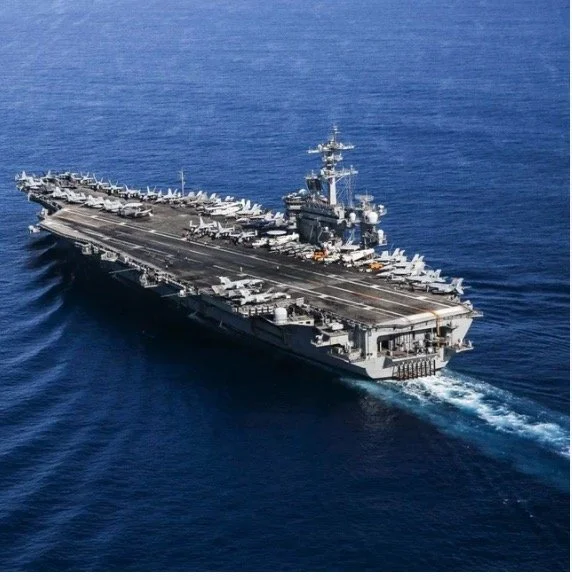
The US President may launch his war of aggression against Iran, for example, with a decapitation strike on the Grand Ayatollah Ali Khamenei. Who should be held accountable if the USS Abraham Lincoln – the most heavily protected vessel in human history – with up to 6,000 US servicemen aboard, with a nuclear reactor on board, bristling with some 90 aircraft and hundreds of different types of missiles, was sent to the bottom of the sea by a salvo of Iranian hypersonic missiles travelling at Mach 8 (about 10,000km per hour)? According to international law, that would be Donald J Trump, the Nobel Peace Prize aspirant. How would Wall Street react?
Send thousands of missiles into Israel to devastate the economy
In 2025 we learnt that Iran, using its older missiles and a swarm of drones, could turn the Iron Dome into the Iron Sieve. Have the Israelis been able to acquire sufficient air defense interceptors to stop what could be a blizzard of thousands of missiles and drones aimed at the key infrastructure of the Israeli economy? Probably not. Will Iran be able to deploy them? Who knows.
Support from Iranian allies in the region
Will the powerful Iraqi Shia militias rise to support Iran and make life untenable for the Americans and other Western interests in Iraq? How will Ansar Allah (the Houthis) respond? Will Hezbollah risk joining the attack?
In truth, none of us know what will happen nor what the Iranians will be willing or able to do after an attack. Time and American violence will provide the answer.
Eugene Doyle