“China is cranking out nuclear submarines faster than dumplings.” Why NZ-Australian defence settings are misguided.
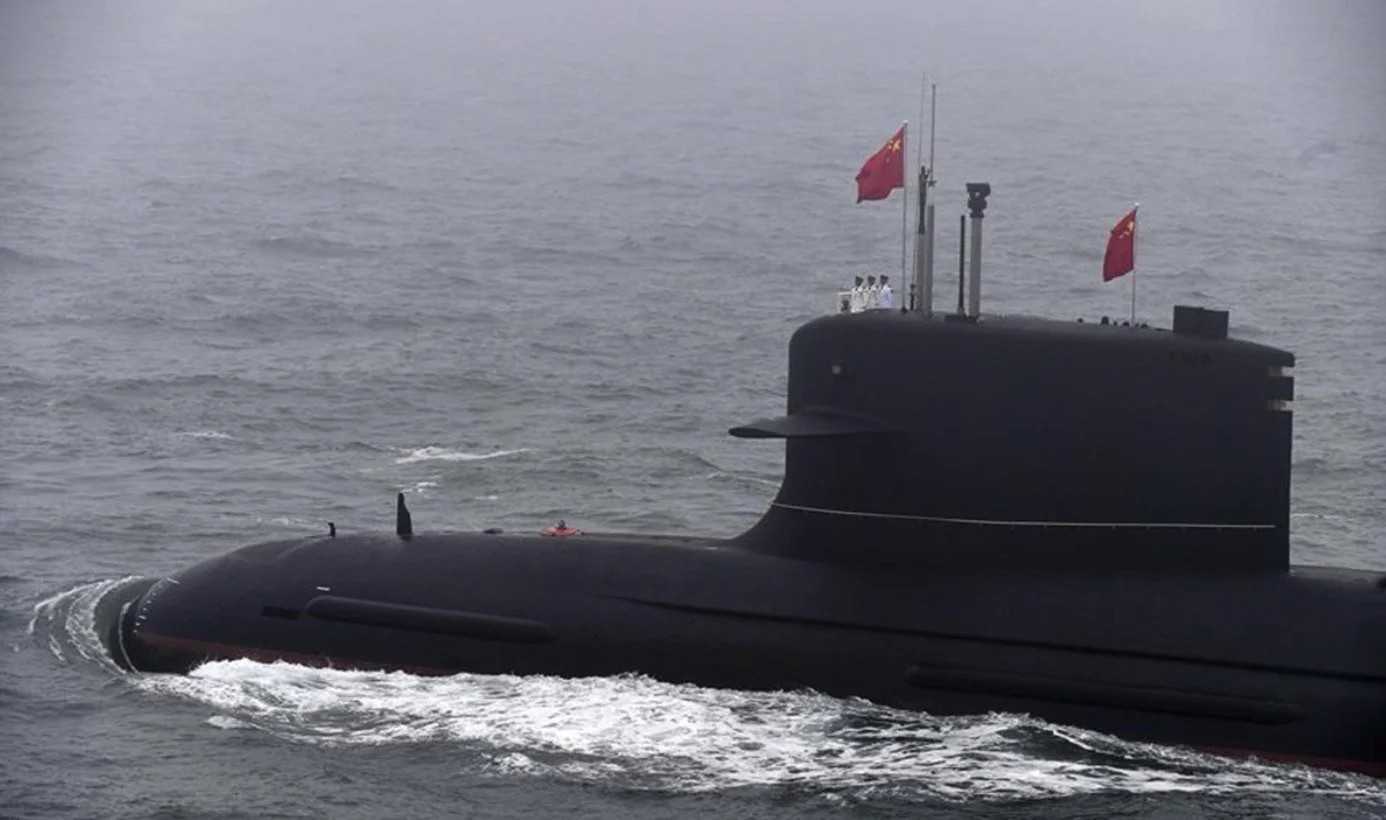
China’s recent launch of a nuclear-capable missile into the Pacific was greeted with howls of protest from the US and its allies. "We are living in a region that is proudly nuclear free. We don't want to see increasing militarisation in our region," New Zealand PM Christopher Luxon said. It came on the heels of his Defence minister suggesting a national conversation was needed about nuclear propulsion because Australia is committed to acquiring nuclear-powered submarines under the AUKUS pact.
And where were the protests from Luxon or Australia's Albanese when this happened:
“Minuteman III test launch showcases readiness of U.S. nuclear force's safe, effective deterrent,” US Strategic Command announced in February 2025. “With over 300 similar tests conducted in the past, this particular test is part of the Nation’s ongoing commitment to maintaining a credible deterrent.”
The destination for most of these 300 missiles – the catcher’s mitt, in US military parlance – were the waters off the Republic of the Marshall Islands. The islands are under such tight US control that they are not allowed to join the nuclear-free treaties Luxon was celebrating. The dark irony is that the Marshall Islands is where the US conducted 67 nuclear tests between 1946 and 1958 – the Bikini, Enewetak, and Castle Bravo explosions. This nuclear militarism, including deliberately exposing civilians to contamination, and the environmental criminality that went with it, helped drive the creation of the nuclear-free zone.
The Chinese, it should be pointed out, fired a dummy warhead so the reference to “nuclear” is reasonable but a slight stretch. There was immediate push-back from the Chinese who reminded people that the missile launch was only their third in decades and complies with international agreements. The Westerners conceded this point.
The reality is that the alliance of Western countries wants to keep the Pacific under their control and to continue a policy of containment against China. Just after WWII General Douglas MacArthur was explicit: the Pacific from now on was an “Anglo-Saxon Lake”. China is a growing power and is more assertive; tensions are rising. At stake is super-power rivalry; something we would be well-advised to refrain from joining. The answer to all this is diplomacy, détente, dialogue and more dialogue – not more frigates, more drones, and more missiles.
I agree with PM Luxon in this one respect: I think we should be proud that the region is “nuclear free" and we should do more to strengthen the reality of that status. I do not want to see Chinese missiles fired into our region. Nor do I want American ones.

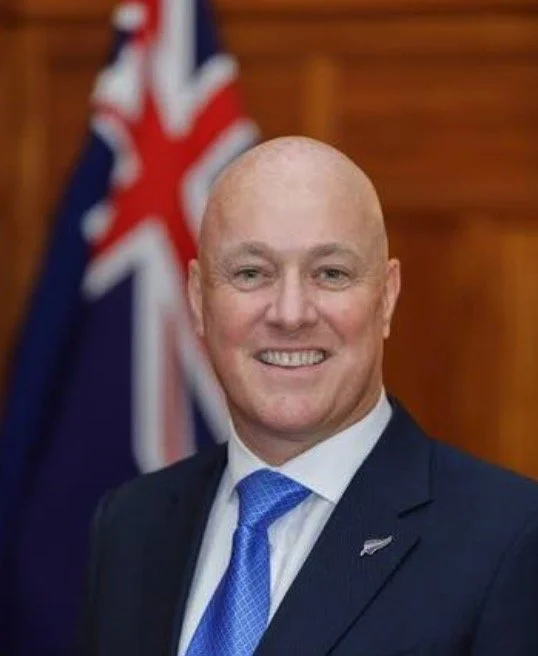


As I write this article, the US is hosting RIMPAC 2026, the world's largest international naval war exercise. New Zealand, Australia and many other Western allies have sent dozens of ships, thousands of personnel for what is in many respects a dress-rehearsal for war with China. It comes at a time when the US is attacking countries on four continents, so I thoroughly support Luxon’s opposition to militarisation; I just wish it was sincere and backed by concrete actions.
Singing from the same choir book as the governing rightwing parties, New Zealand Labour leader Christopher Hipkins said the launch was a concerning development. “We want to see the Pacific stay an ocean of peace, and China's testing of their ballistic missile capability in the Pacific is very unwelcome."
Ocean of Peace? The newly-established Ocean of Peace Alliance, signed on July 6, 2026, binds Australia and Fiji to assist each other in case of conflict. The Chinese interpret the alliance as an unfriendly move, a “geopolitical tool" that advances an anti-Chinese agenda. Its creation was seen by some analysts as one of the drivers behind the timing of the Chinese missile launch. Hipkins has signalled that Labour is “broadly supportive” of the Ocean of Peace pact which the Coalition government is considering joining.
Green Party foreign affairs spokesperson Teanau Tuiono was a strong counter-voice when he told Radio New Zealand: "People talk about an Ocean of Peace, and I think that's a good thing. So we should try to make the Pacific a place of peace, but that would require us to commit to demilitarisation, to actually commit to peace, and making sure that we're very clear, particularly to the big powers – the US, China, and whoever else – that that is what's important for the Pacific."
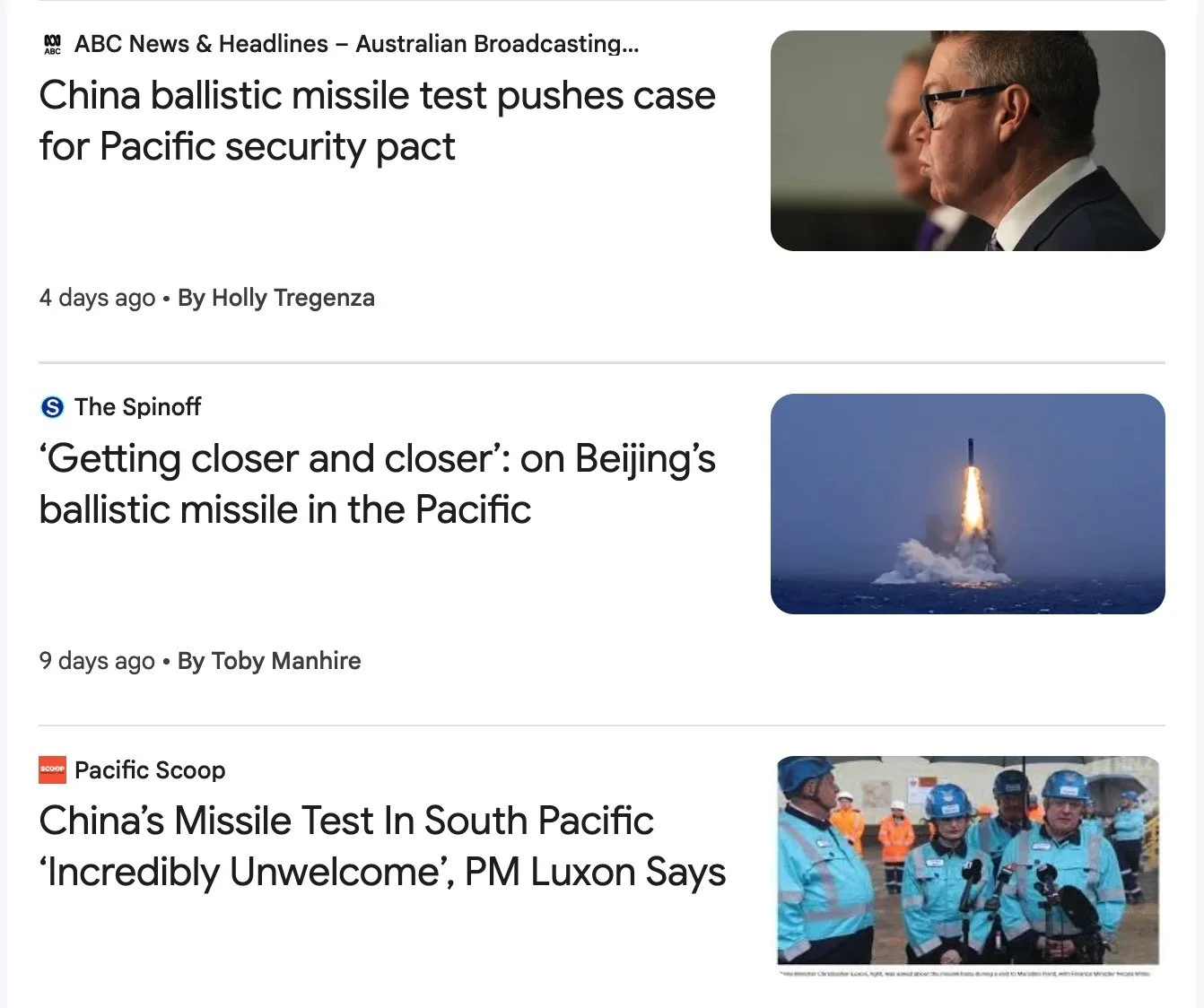
New Zealand’s decision to double its military spending over the next few years is the opposite of this track. The cost to the country, for a medium-sized economy like New Zealand’s, is enormous. The fact that much of the spending is focussed on increasing our interoperability with the Americans, the purchase of American weapons and the integration of American tech into our defence, intelligence and foreign affairs establishments is a clear signal to China that New Zealand likes them buying our butter and wine but is preparing to fight alongside the US if hostilities break out. This is madness.
Carl Zha, host of the Silk and Steel podcast, is a perceptive, often caustic, critic of Western positions on China. Zha laughs off the “big ruckus being raised by the United States and all the U.S. vassals like Australia, New Zealand.” His interpretation of the missile launch is that it is about deterring the US from recklessly attacking the Chinese mainland. He told Jamarl Thomas this week:
“What China has demonstrated with this launch from a Chinese sub is that China has second strike capability. China has been cranking out nuclear subs like dumplings in recent years. This year they just made two additional ones. So China's saying: hold your horses. MAD (Mutually Assured Destruction) is still in effect.”
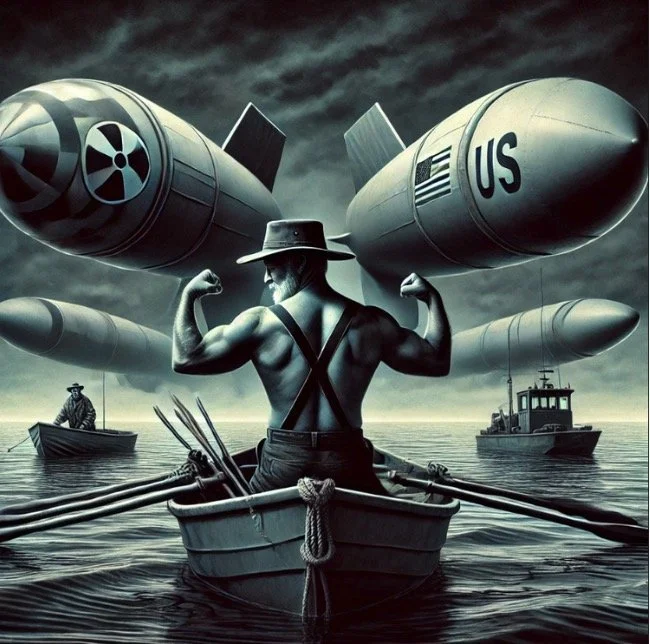
New Zealand pumping billions into defence is a drop in the Pacific compared to the major powers. It wastes resources that could go into developing our infrastructure, our communities and our education and health systems. We are prioritising ratcheting up tensions and we risk being drawn into an unwinnable war rather than investing in developing our own societies.
It is always worth remembering that China last fought a war in 1979 (briefly with Vietnam). In all the succeeding years the US has never not been at war. China has never threatened, let alone attacked New Zealand, yet our government is taking an increasingly hostile posture towards China to please a rogue US state. China is fully aware that New Zealand – thanks to the Luxon government – now calls it (our greatest trading partner) a “strategic competitor”. This seems very much like biting the hand that feeds you.
When a US-China war starts everyone will have instant regrets. Few will have wanted to see the missiles fly, the cities bombed, the ships sunk, the lives lost. Unlike the US-Israeli attack on Iran, this will not be started with a deliberate act of aggression and a furious will to destroy an opponent. It is most likely to start by a cascade of mis-steps, a series of political blunders (I’m betting on the US for that one) that claws and scratches its way up to kinetic actions. Once it kicks off, within days or weeks, the world we inhabit could change forever. War is too terrible a thing to leave to leaders.
Eugene Doyle
Eugene Doyle is a writer based in Wellington, New Zealand. He has written extensively on the Middle East, as well as peace and security issues in the Asia-Pacific region. He hosts solidarity.co.nz.
This article may be reproduced without permission but with suitable attribution.